
To August
On my favorite month, in which time feels its strongest.

Dear Reader,
How’s your summer been?
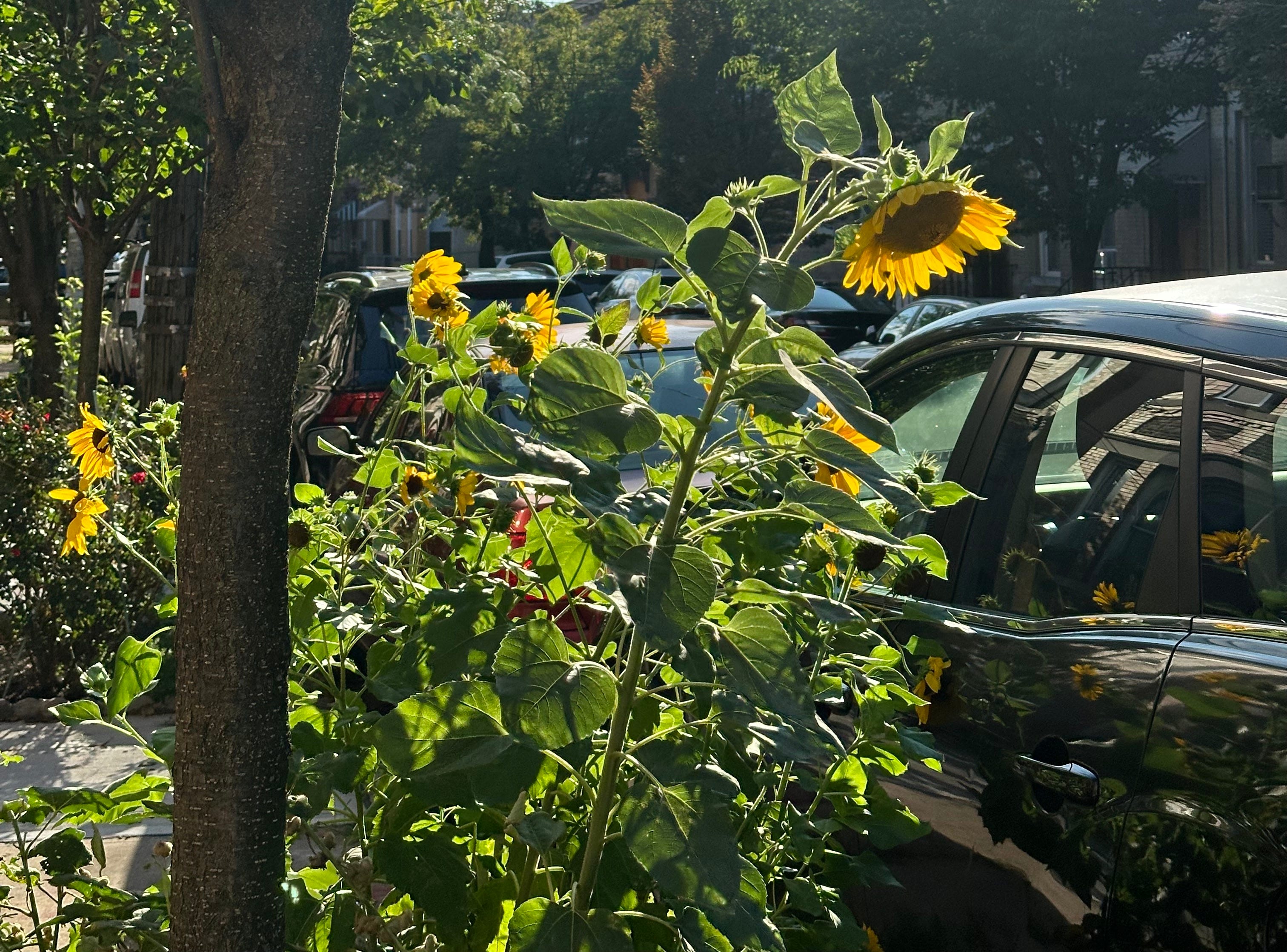
August offers a dichotomy: It flies at hyper speed but everything feels sticky. The nights are shorter, the sun is quieter, the sunflowers are here, there’s more time to wander into the night. The sunflowers will, of course, die as quickly as they bloom. They will return to the soil, their seeds scattered, growing roots somewhere we cannot see until the next August rises from them, yellow.
Winter is forever. But summer? Summer is once.
Anyway, this summer I’ve been thinking a lot about my creative projects and where I want to go next. I’ve been writing music criticism for almost a decade so now feels like a good time to set some new goals! It’s also my birthday in a few short weeks, which is always a time of reflection.
If you’ve been reading (which, thank you), you’ll know as the years have gone on, my writing is less about music and more about time and the intersection of the two. I want to write about listening through the seconds and watching ourselves change within them. Substack has been a place to explore those ideas and experiment with style, mostly by sharing the scenes I write in my notes app after shows and the things that don’t get published elsewhere. I’m going to keep doing that here! But I want to go deeper someday soon. I’m building a philosophy! Join me?
Thoughts? Feelings? Comment below.
Until another summer finds us,
Vanessa
For those of us preoccupied with the great beyond, legacy is no stranger. The same goes for being an artist. Will I be remembered for the words I wrote, immortalizing the fleeting moment of music for history to bear witness? I hope not. An easier question is for whom I write. They ask me about this in Journalism school, at conventions, after a show. We all write for ourselves, I respond, but I also like to think I write for the future. I write down memories that others might be curious to live; I write stories about music and the people who loved it for those who will, someday, love it too. Most of all I write for those who, like me, feel small when looking out at the Pacific Ocean as the sun rises against the dew and thousands of birds caw, now and in the future; those who wonder about the mysteries of sound, of listening, of the inexplicable magic of experiencing music together in a room and how fleeting yet eternal it all is. I write to remember the sound I heard and how it changes, always, forever.
“I don’t know what this one’s about. That one has a plaque, but this one is blank,” she says to her friend as they peer into a deep violet stroke of paint from Mark Rothko’s brush. She sits for a few minutes, trying to find something to hold. Perhaps the frustration is the meaning, I wonder, sitting on the opposite side of the bench. Rothko allows any emotion to surface. As she looks, coldly, I stare into a different canvas, half black, half gray. The rough-hewn paint gives the piece dimension, like it could be a portal into another universe. I glance inside and wait for something to speak to me. I grasp at a response and hope for forgiveness when necessarily it is not enough. I forget to blink and my eyes glaze over. Forty-five minutes have passed and here I am laid bare at the altar of a painting, no further from myself.
At five in the morning, thousands of birds chirp together. Their individual calls are indistinguishable. It’s instead a roar of caws and shrieks and yelps and coos, the kind of din humans conceive from amplifiers and feedback but that really belongs to nature. I walk down to the beach. The tide has rushed out, far past the shore, leaving behind hundreds of new miles of rippled gray sand, bleached driftwood, a decomposing skeleton, tubes of washed-up kelp, and dried red seaweed. Terns, gulls, and eagles swirl about the sky and land on the sand, running out to sea and back again, singing wherever they go. It’s easy to feel anonymous in New York, but harder to feel small. Immenseness belongs to the ocean, of which we know very little. Éliane Radigue dedicated her later years to that vastness, asking again and again and again how sound can take us to the deep. Do the birds share that desire? As they fly away, one by one, made tiny by the growing distance, their calls disappear into the wild, into the air, into the sea, a mass of sound disintegrated into all that can never truly be known.
It’s June and the nights are still long; the air is still thin; the sky is still light in the middle of the day; I’m held down by the weight of knowing I’m on the last page of a book. Summer is supposed to be about joy! Or is it hedonism? The air will thicken faster than a millisecond passes and before I know it, the sun is setting before 8pm, the sky is dark yellow, the sunflowers have returned. I say a prayer for another day to remember what it felt like when everything was easier, the story was just beginning, the memory was still a moment left to be lived. I stand on the street corner away from everyone I know. The light wanes. I close the book and flip it over. It is written, it was read. The freedom I sought wasn’t debauchery — it was the choice to freefall into the unknowability of other people, of myself, of the earth, of the dictator called time. I wanted to make that choice this summer and then I didn’t, not really, not yet. The end is so terrifying that I stop the process of change in its tracks, even though the seconds always pass, no matter how hard I try to hold them in my palms, so I guess I’ll stow the book on the shelf with the others to revisit next August, when everything is different no matter how tight my grasp on the clock’s hands.